
I remember the army officers standing at the office door.
My father had gone to work as he always did, providing for his family through a small oil distributorship in Egypt. That day he came home and sat us down. The company was no longer private. It belonged to the state. The officers had sent him and his colleagues home as if a lifetime of labor could be erased by a government order.
I remember learning to speak in whispers.
Under Gamal Abdel Nasser, informants were everywhere: in workplaces, neighborhoods, schools, even among students. My parents warned me to be careful about what I said. A careless word could travel faster than a child understood.
I remember the library.
As a young man, I checked out books about America—about freedom of speech, freedom of religion, and the right to say what you believed without fearing the knock at the door. I was mesmerized. I was also afraid someone might report what I was reading. That is how oppression works. It does not have to arrest everyone. It only has to teach everyone to be afraid.
I Learned Freedom by Losing It
I was born into Egypt’s Coptic Christian community in 1948. Four years later, nationalist military leaders forced King Farouk into exile. Nasser soon became, in effect, the dictator of an Islamist-socialist military regime.

The words sound academic until they reach your kitchen table.
Banks were nationalized. Foreign commercial holdings were nationalized. Private companies and land were seized. Christians who had lived in Egypt for centuries became second-class citizens. Highly educated believers were pushed out of leadership and into menial work. Churches were restricted. Evangelism was confined. Speech narrowed until even home felt unsafe.
Not all Muslims were hostile to me. I had Muslim friends from moderate, enlightened homes, and I thank God for them. I am not writing with contempt for people. I am writing against ideologies that make neighbors afraid of one another and replace conscience with control.
I left Egypt in my teens with the clothes on my back. I did not come straight to America. For years I lived and worked elsewhere, and in 1977 I moved to the United States from Australia. I became a citizen in 1984. That order matters. I was already free. I still chose America because, in my heart, I had loved her freedoms long before I held her passport.
And so you understand my heart and why I must speak out when I see socialism become a celebrated campaign platform in America.
A Movement Can Become Normal Before It Is Loved
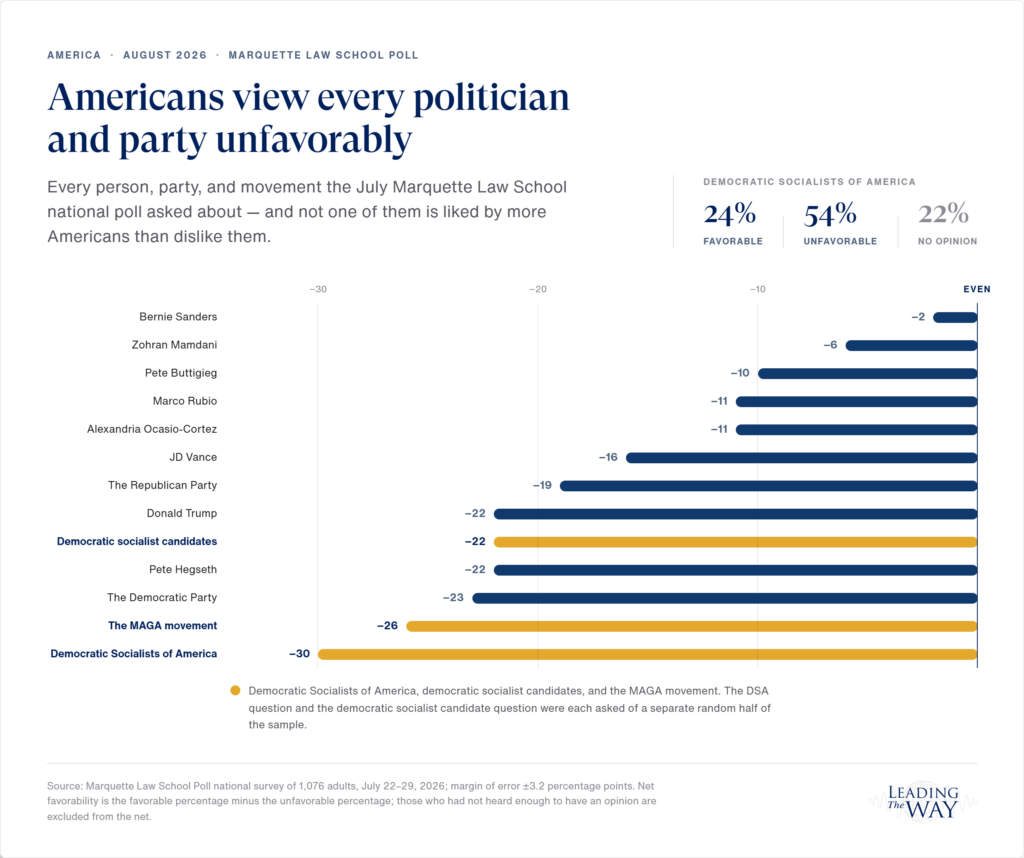
I know many Americans do not think they are embracing socialism. The numbers bear that out. A Marquette Law School national poll released just this month found the Democratic Socialists of America underwater with the public: 24 percent favorable, 54 percent unfavorable. Among independents, the numbers were even colder.
But that is not the whole story.
The same poll split its sample. Half were asked about the organization. Half were asked about democratic socialist candidates. The organization stood at a net minus 30. The candidates stood at a net minus 22. For scale, MAGA stood at a net minus 26. Not one name in that poll came out ahead, and that fact should humble anyone tempted to triumphalism.
Still, the comparison reveals something serious. The label is more toxic than the people carrying it.
Bernie Sanders, the best-known socialist figure in American politics, stood at 45 favorable, 47 unfavorable, with only 8 percent saying they had not heard enough. He was two points from even while Donald Trump, whom almost no one lacked an opinion about, stood at a net minus 22, and Vice President JD Vance, known to just as many people as Sanders, stood at minus 16. That does not mean America has embraced socialism. It means an ideology can be rejected by name and still become normal through personalities people trust.
That is how ideas travel. They do not always arrive wearing their own uniform.
On August 4, Abdul El-Sayed narrowly defeated Rep. Haley Stevens in Michigan’s Democratic U.S. Senate primary. Socialist state legislator, Francesca Hong lost the Wisconsin democratic primary for governor by less than 4,000 votes. And most alarmingly, the Democratic Socialists of America are now the largest socialist organization in United States history, reporting more than 120,000 members as of July 4, up from roughly 5,000 a decade ago, and exceeding the peak membership of Eugene Debs’s Socialist Party in 1912.
A movement does not need to be loved to become powerful. It only needs to become familiar.
View this post on Instagram
When “Forever” Belongs to Government
In an August 9 interview on ABC’s This Week, Rep. Alexandria Ocasio-Cortez spoke of “a time of renewal for the Democratic Party” and “an ascendance of a young, inspiring, exciting electorate.” Young people are carrying real economic pain, and she said plainly that many feel ignored, sidelined, and burdened by decisions made before them.
That objection deserves to be heard honestly.
A young family struggling with rent, groceries, medical bills, and debt may hear warnings about socialism and think, “You are defending a system that is not working for me.” I understand why a promise of affordability sounds compassionate. I understand why “renewal” sounds hopeful. But renewal of what, and toward what?
In that same interview, Jonathan Karl read from the DSA’s own adopted national platform: defunding the Department of Defense, closing overseas military bases, abolishing the police and prison system. She did not endorse those positions. Her answer was, “No, but I think that this is a free country. Everyone can have all sorts of beliefs,” and then she redirected to lowering bills and helping people afford a doctor.
That exchange is a warning about a mechanism, not about a person. Radical content can be carried quietly inside a movement whose public face is compassion. The platform is not defended. It is not fully repudiated. It is set aside as an academic debate while the argument moves to affordability.
The most dangerous ideas are not always the ones a nation argues about. Sometimes they are the ones it stops arguing about.

Months earlier, at the University of Chicago Institute of Politics, David Axelrod asked whether she would run for president or for Senator Schumer’s seat. She answered that her ambition was not a title or a seat. “They assume that my ambition is positional. They assume that my ambition is a title or a seat. And my ambition is way bigger than that.”
Then: “Presidents come and go. Senate, House seats, elected officials come and go. But single-payer healthcare is forever. A living wage is forever. Workers’ rights are forever. Women’s rights, all of that.”
My friends, I hope you are listening. That is a serious claim about permanence.
I have heard “forever” before. I heard it from regimes and ideologies that believed they could own the future. Nasser is gone. His boast is gone. The Church in Egypt is still there.
Only God owns forever.
What does the Psalmist write?
“Now therefore, O kings, be wise;
be warned, O rulers of the earth.
Serve the LORD with fear,
and rejoice with trembling.
Kiss the Son,
lest he be angry, and you perish in the way,
for his wrath is quickly kindled.
Blessed are all who take refuge in him.”
ESV text: Psalm 2:10-12
Psalm 2 does not flatter kings, parties, movements, or crowds. It tells rulers to be wise because they are accountable to the Lord. It tells nations that rage against His authority that they are not owners, only renters. They may not see the Owner with their eyes, but He will come.
Freedom without authority becomes anarchy. Authority without freedom becomes slavery. True liberty lives under the authority of the Word of God.
What Faithfulness Requires Now
Some Christians tell me political neutrality protects our Gospel witness. I understand that concern. I have seen believers confuse the Kingdom of God with earthly parties, and that is a grave mistake.
But silence in the face of evil is not faithfulness. Salt that stays in the shaker preserves nothing. Jesus did not call His people to panic, rage, or sneer. He called us to be salt and light in Matthew 5:13–16, to love our neighbors enough to speak Truth before the chains are fastened.
In my most recent book, An Unholy Alliance, I have warned that Marxists and Islamists may hate one another, but they can still work together when their common enemy is Biblical authority. I saw the joining of those forces in the Egypt of my youth. I saw another form of it in Iran in 1979, when leftists and Islamists helped bring down the Shah, only for Khomeini to destroy the leftists once he held power. One side imagines it can use the other. In the end, tyranny devours its partners.
My plea is not for Christians to become harsh. I pray for those who are lost. I long for them to know the loving God. I rejoice whenever I see someone come to Christ.
My plea is for courage with tears.
America’s freedoms are not self-sustaining. They depend on moral foundations deeper than law, deeper than elections, deeper than slogans about renewal or forever. When government becomes provider, savior, parent, priest, and judge, it does not merely mismanage the economy. It tries, and always fails, to replace God.
I fled that kind of world once. I do not want to watch my adopted country walk toward it without knowing where it leads.
So I am asking you to join more than half a million believers who are praying for our families, our churches, and our nation — not as a substitute for courage, but as its source. A nation that has forgotten God will not be argued back to Him. He must draw her home. Our part is to ask.
Listen to Work for God’s Glory
Share
Recent MY Journal
Uncovering the Islamist Strategy for Domination
October 11, 2026
First Large-Scale Navigator Shipment Reaches the Middle East
October 9, 2026
Sign Up for Ministry Updates